

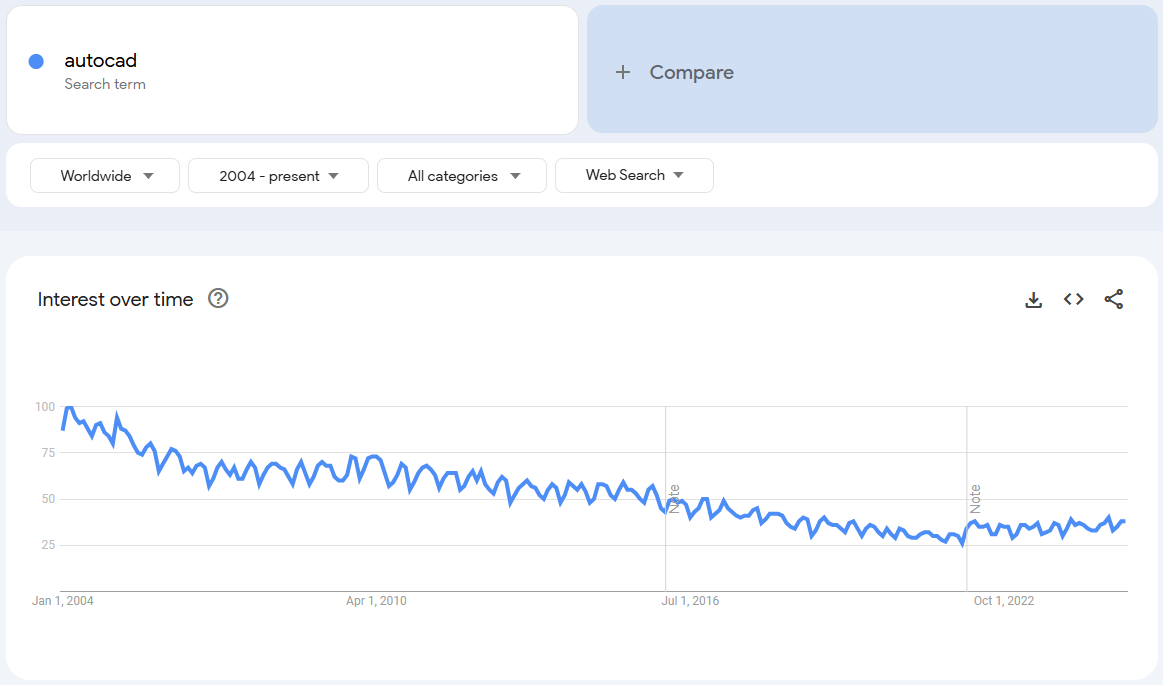
So here is a Google Trends graph showing a decline in global searches for the term AutoCAD from 2004 to now.
And here is another graph showing a rise in global searches for the term Revit from 2004 to now.
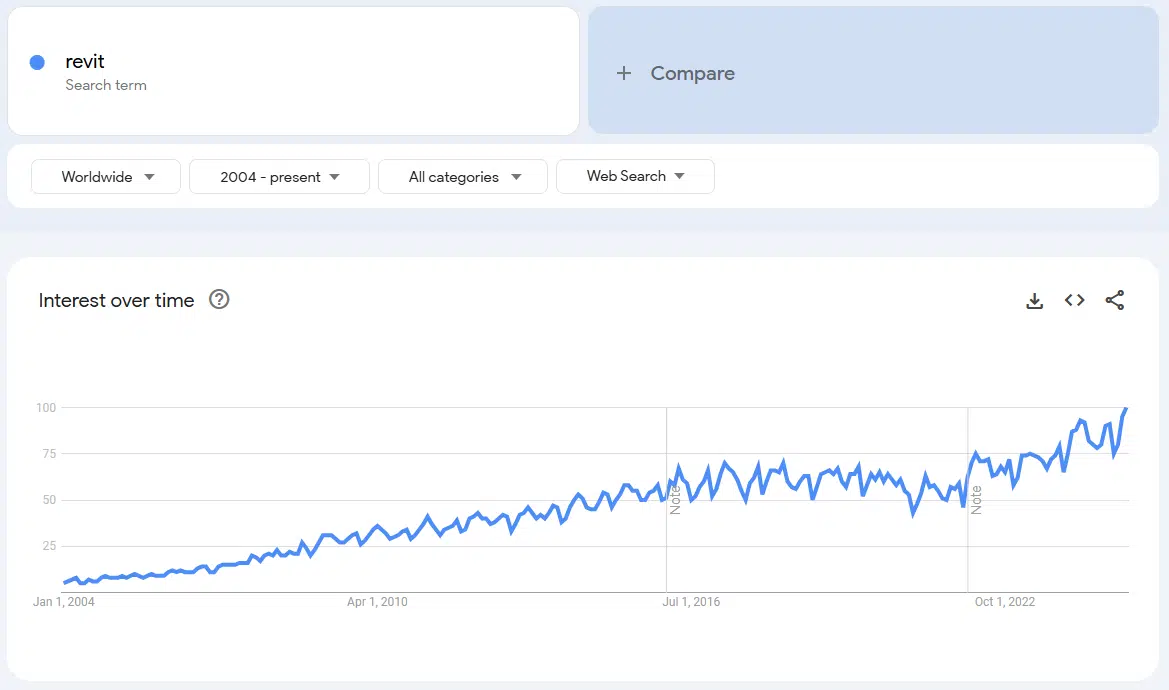
Anyone looking at this graph might draw a conclusion that AutoCAD is an endangered species and it is on its way to extinction.
But it’s quite the opposite.
By the way here is the video version of this article as well.
Why this Question
I see those comments. You guys are relentless!
'Why are you still using AutoCAD? Revit does it faster!'
Ok, I get it, you really like Revit, but let's be real for a second.
Would you use a FIREHOSE to water your delicate garden herbs?
Imagine the carnage! Plants obliterated.
That's what using the wrong tool feels like.
AutoCAD?
Think of it as your trusty garden hose: precise, controlled, perfect for the job at hand.
Revit?
That's your firehose: powerful, specialized, and potentially devastating, at least cost-wise, if used incorrectly.
They are both different software made for different purposes.
They can be used interchangeably in some situations but essentially they are different.
Where AutoCAD and Revit stand
AutoCAD is the master of 2D drafting.
If your project is simple, technical, and requires precision, AutoCAD is your tool.
It's the digital evolution of the drawing board.
And yes, it has 3D, but let's be honest, it's like a bonus feature on a classic car.
Nice to have, but not the main attraction.
Need to design a machined part? AutoCAD makes it a breeze.
Well, with Revit?
Prepare for a digital nightmare with machining or fabrication drawings.
AutoCAD shines in small fabrication shops, for panel designs, for simple house plans.
It's the ultimate blank canvas.
Revit, while powerful, locks you into its pre-built parametric world.
But it really shines in large BIM projects and AutoCAD is nowhere near its powerful capabilities.
So Why Does AutoCAD Look Like It’s Dying?
Now, about that Google Trends graph I showed you at the beginning of this email.
You know, the one that screams, 'AutoCAD is dying!'?
Don't be fooled!
It's a classic case of smoke and mirrors.
What if I told you the real story involves hidden players and a market shift you never saw coming?
And this story involves BricsCAD, ZWCAD, ACTCAD, and many more silent giants.
BricsCAD launched in 2002, ZWCAD’s initial release was in year 2000 and then Revit also launched at the same time.
So they siphoned off a massive chunk of AutoCAD users because now they have cheaper alternatives in the form of BricsCAD and ZWCAD and specialized software that gets their specific job done in the form of Revit.
So, with the rise in market share of these software as shown in this graph, the decline in AutoCAD's share is obvious.
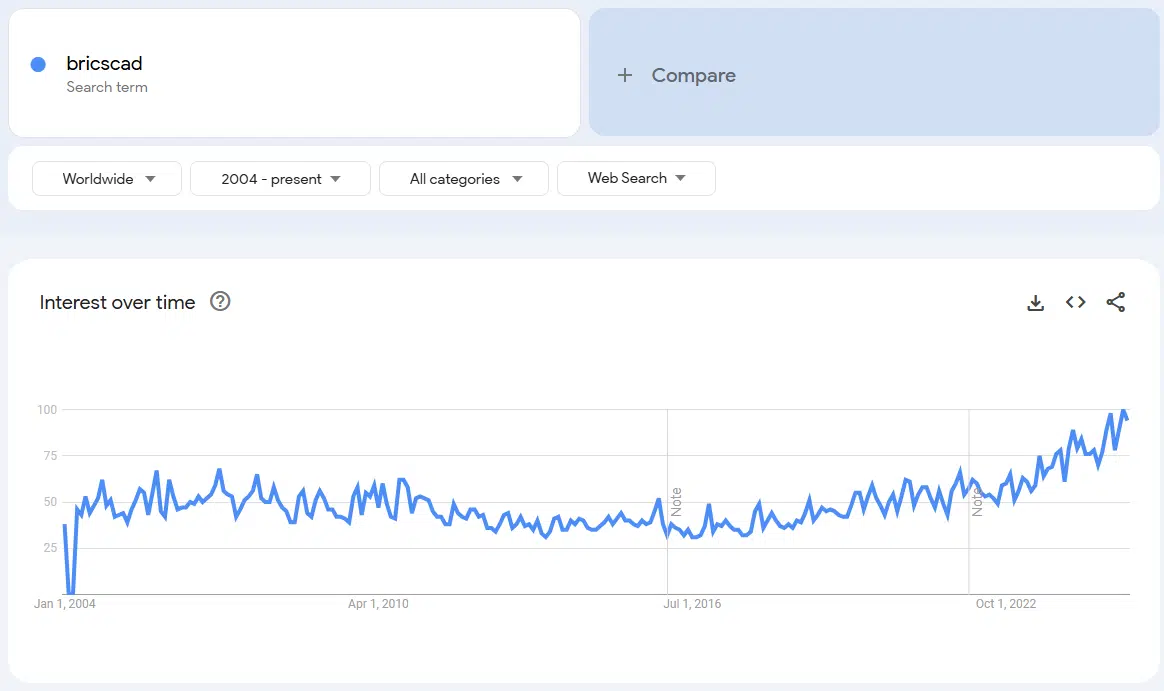
Suddenly, the search trends make a lot more sense, right?
It's not that AutoCAD is fading.
It's that the landscape is changing and other cheaper and specialized alternatives are taking it’s market share.
Even within Autodesk, several specialized toolsets appeared, like AutoCAD Electrical and Civil 3D in 2005, further taking a chunk from AutoCAD's market share.
So, the user base of AutoCAD didn't vanish; it evolved and moved to Revit, Civil 3D, AutoCAD Electrical, and other competitors.
So, that means AutoCAD is dying, right?
Actually, still a big No.
Many companies start with AutoCAD.
It's the gateway to the CAD world and when they need more specialized toolsets, they upgrade.
But millions still find AutoCAD perfectly sufficient and they don’t jump to other specialized software.
So, even though it's user base is not as big as it used to be, it is not dying.
It has it’s own market and own use cases where it is undoubtedly the strongest piece of software.
With new industries starting their foray in the CAD world with AutoCAD, it is still a strong and dependable piece of software and it will remain so for years.
So, that was my take on this specific question on Revit vs AutoCAD and is AutoCAD dying.
Now what is your take on this burning question?
Do you think AutoCAD is still a dying species and it is on its way towards extinction?
And did I missed any point or overlooked something that might have added value to this conversation?
Let me know by sharing your comments down below.